
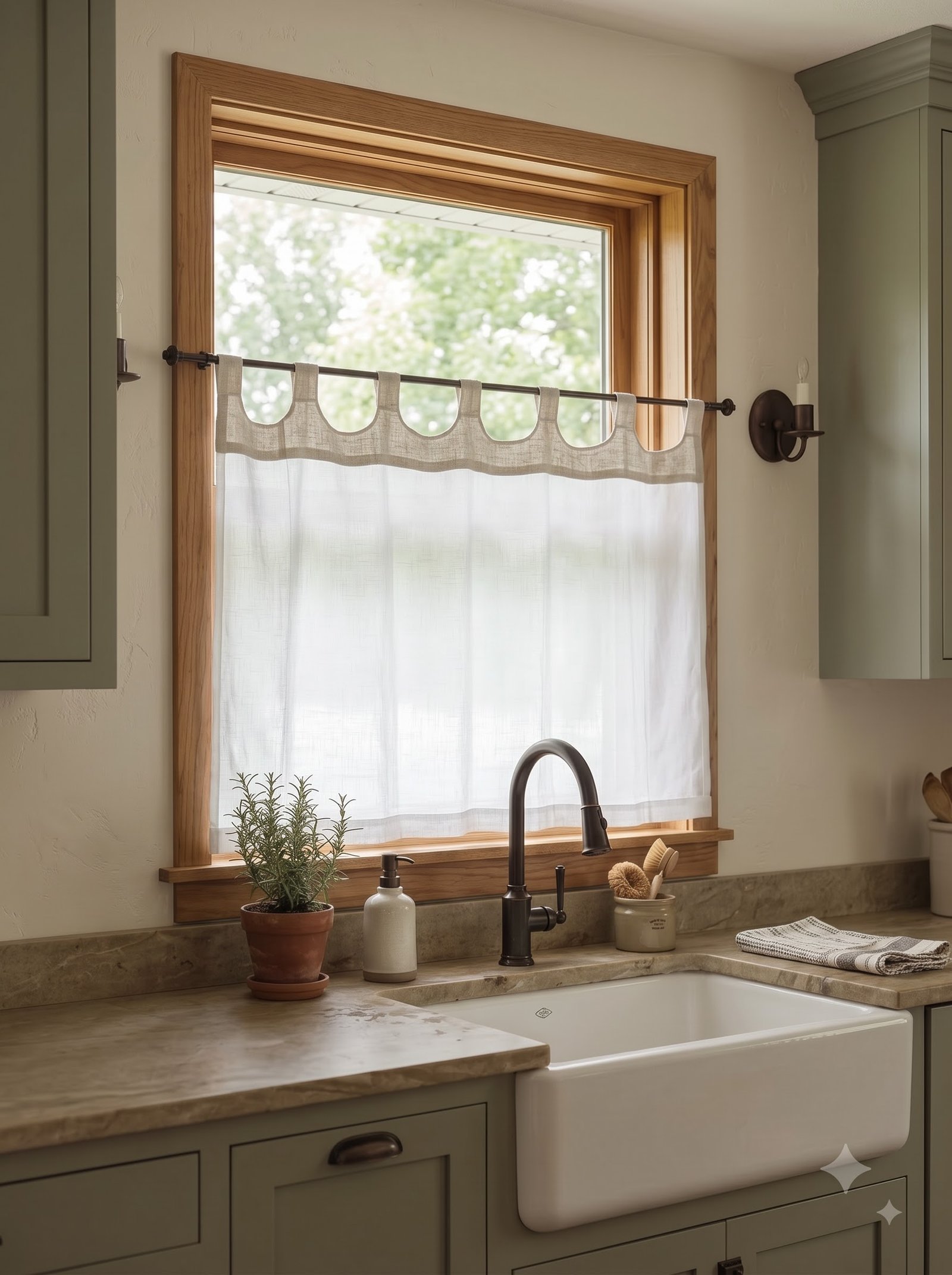
One Café Curtain Panel or Two? Width and Access Guide. Panel count changes both the look and the way you reach the window. A single panel gives an uninterrupted surface, while a pair creates a central opening.
Panel count changes both the look and the way you reach the window. A single panel gives an uninterrupted surface, while a pair creates a central opening.
Choose panel count around access and the visual center
Think about where you normally reach for the latch and whether you want to move the curtain during the day. State whether your requested width applies to each panel or to the pair combined.
A pair creates a central division, which may suit a symmetrical window or make it easier to reach a central latch. A single panel creates an uninterrupted fabric surface but may need to slide differently. Consider where supports sit and how often you move the curtain. The aesthetic decision should be made together with the practical one, especially on a narrow window where two headings could feel busy.
A realistic decision in your own home
For a window used frequently, sketch the direction in which each panel would move and show any fixed support in the middle. If a pair is preferred, label left and right even when they are the same size. This prevents an order for two panels from being interpreted as one wide finished panel.
A practical way to test your idea
Write your order note as either two panels at a stated width each or one panel at its full finished width. Add the desired drop separately.
A common ordering mistake
Avoid the phrase double width without explaining it. It can refer to a wider panel, a pair or additional gathering, depending on the conversation.
Does a pair mean the listed width is doubled?
Not automatically. Listings and custom briefs can describe width per panel or for the pair. Confirm the convention for the selected item. Write the quantity and finished dimensions of each panel explicitly rather than relying on the word pair to communicate both.
Draw the direction each panel needs to move
Panel count changes access as well as symmetry. Mark the latch, any fixed center support and the direction in which the curtain would move during normal use. A pair may make sense around a central opening, while a single panel can provide an uninterrupted surface. Neither should be selected without considering the hardware. A quick plan helps distinguish an aesthetic preference from a practical requirement, particularly on a small window where additional headings may occupy valuable space.
Can the two panels have different widths?
Discuss that if the opening or access needs are asymmetric. State the finished width for each panel and label left and right. A custom pair does not have to be described as equal halves if that is not the intended design.
| Information | What to explain |
|---|---|
| Usable span and panel count | Measure the area where the curtain can actually hang. State one panel or a pair, and identify whether your proposed fabric width is per panel or combined. |
| Finished drop and heading reference | Mark the intended lower edge in a photo. Ask where the chosen design measures its length from, including how the top detail relates to the rod. |
| Hardware and intended coverage | Give the rod diameter, mounting position and any obstruction. Describe the amount of glass you want covered and whether the curtain must move frequently. |
Pieces to explore