

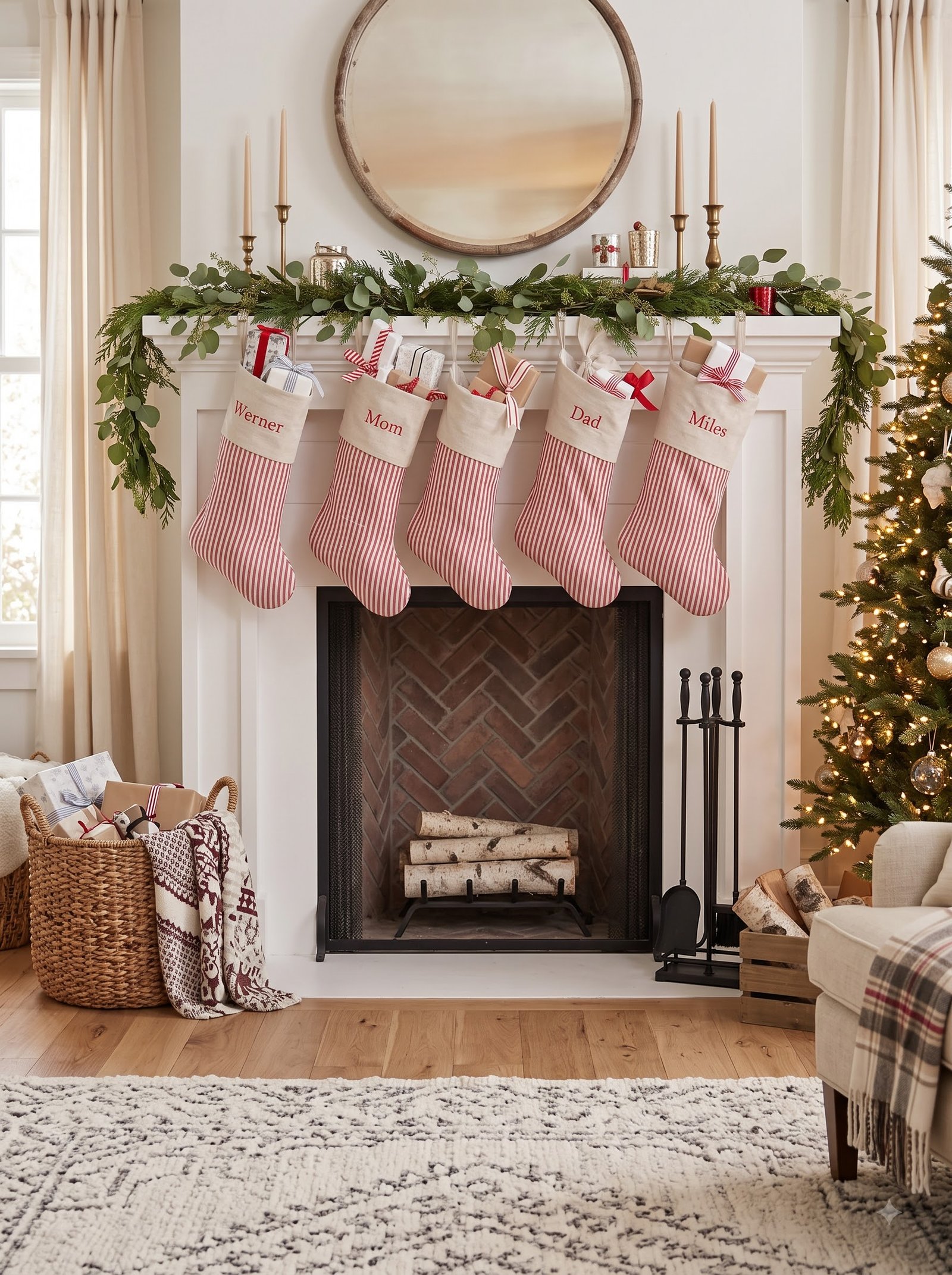
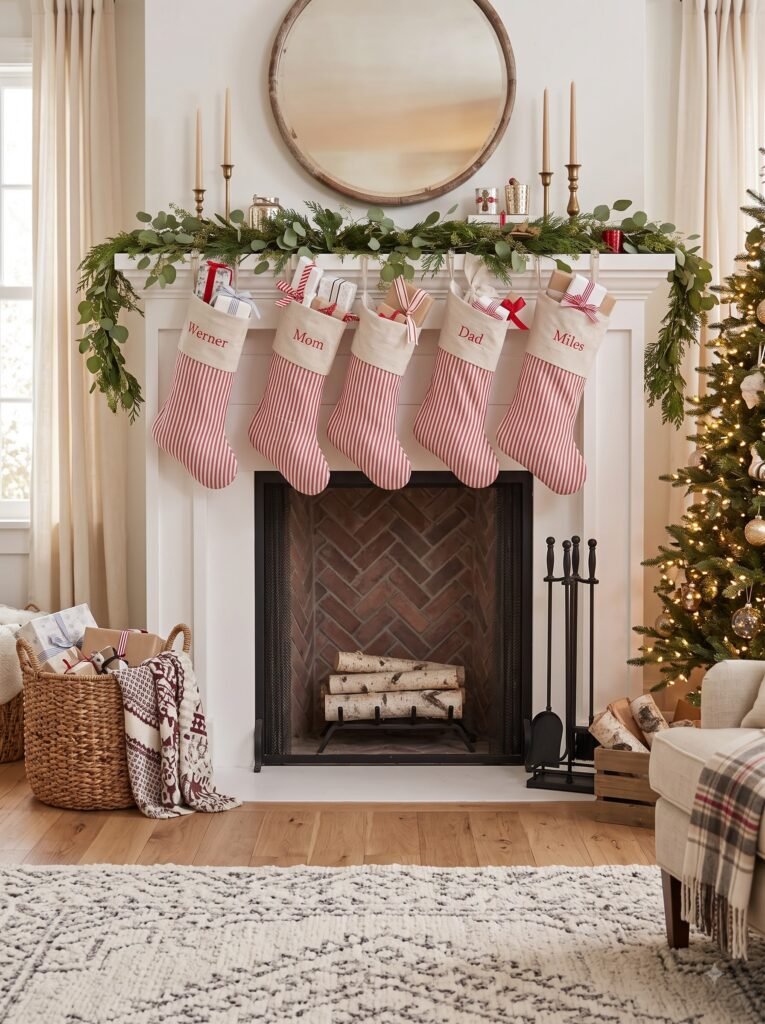
Christmas Stockings. A family stocking display can feel unified without giving every person an identical design. Repeat a few visual details and let scale, spacing and color do the work.
A family stocking display can feel unified without giving every person an identical design. Repeat a few visual details and let scale, spacing and color do the work.
Choose what stays consistent and what can vary
Choose a consistent top line and leave similar gaps between stockings. If one piece is wider, balance the arrangement visually rather than forcing identical center-to-center spacing.
A coordinated stocking collection works when there is a recognizable connection across the display. That connection might be a color, a cuff proportion or a repeated material. Everything else does not have to match. This is especially helpful for families adding pieces over several years. Keep a record of the original dimensions and photographs so a later addition can relate to the collection without relying on memory or a similar-sounding product name.
A realistic decision in your own home
For a family with three existing stockings and one new addition, arrange the old pieces first and measure their visible proportions. Decide whether the new one should blend in or be intentionally distinct. Then send a clear photograph of the group and explain the relationship you want. This is a different brief from ordering four identical pieces.
A practical way to test your idea
Arrange paper silhouettes on the wall first. Label them with family members' names and adjust their order before installing the final display hardware.
A common ordering mistake
Do not assume decorative hanging loops or mantel hooks are designed for a heavy load. Use the product and hardware guidance for your actual display.
How do I make different stocking sizes look balanced?
Start by aligning the hanging points or cuffs, then adjust the gaps by eye. A wider piece may need a little more space. Use paper shapes to test the arrangement before installing hardware. Balanced composition does not require every stocking to have identical dimensions.
Make later additions easier to coordinate
If a collection will grow with the family, retain information about the original group now. A straight-on photograph shows proportion, while measurements explain the details that a photograph cannot establish reliably. Note which element is meant to stay consistent, such as the cuff line or the color relationship. When requesting another stocking later, describe that intention rather than asking for an unspecified match. Available materials and options should still be confirmed for the new order.
Can a new stocking be intentionally different?
Yes. A repeated color, scale or display position can connect it to the others. Explain whether you want a close relationship or a deliberate accent so the maker understands the role of the new piece within the group.
| Information | What to explain |
|---|---|
| Finished height and measuring points | Show the top and bottom reference points on a sketch. State whether the loop or cuff is included so a single height cannot be interpreted in two ways. |
| Opening and shape | Give the flat cuff width and explain any important foot or outline proportion. Mention whether the piece is mainly decorative or intended to hold particular small gifts. |
| Display relationship | Photograph existing stockings if coordination matters. Explain which details should repeat and which can differ, and keep hanging hardware requirements separate from the textile brief. |
Pieces to explore
Comments (1)