For custom men’s linen trousers, record where you want the waistband to sit before discussing the leg length. Then separate body circumferences from the dimensions of any trousers you use as a reference. This guide gives named reference methods so a waist, rise and inseam cannot be mistaken for three versions of trouser size.
Record the body at the intended waistband level
Stand naturally and run a flexible tape around the level where you intend to wear the trousers. Keep it level and comfortably close, without pulling it tight to reproduce a familiar size label. Write the location as well as the number. Record natural waist separately if the design or studio requests it.
For the seat, find the fullest relevant circumference and check the tape behind you in a mirror or with help. For a thigh reference, measure one leg at the fullest upper-thigh level without compressing it and name that position. If the studio asks for a point at a stated distance below the crotch, take that as a separate specified method rather than silently substituting your earlier reading.
Explain whether restriction appears when sitting, stepping or standing. Keep the observation outside the body figures so the maker can interpret actual size and preferred movement room separately.
Lay out a reference pair
Close the fastening, empty pockets and arrange the legs on a flat surface without stretching. Use a similar woven pair where possible. Mark readings from a stretch pair as such; their dimensions do not automatically reproduce the same comfort in non-stretch linen.
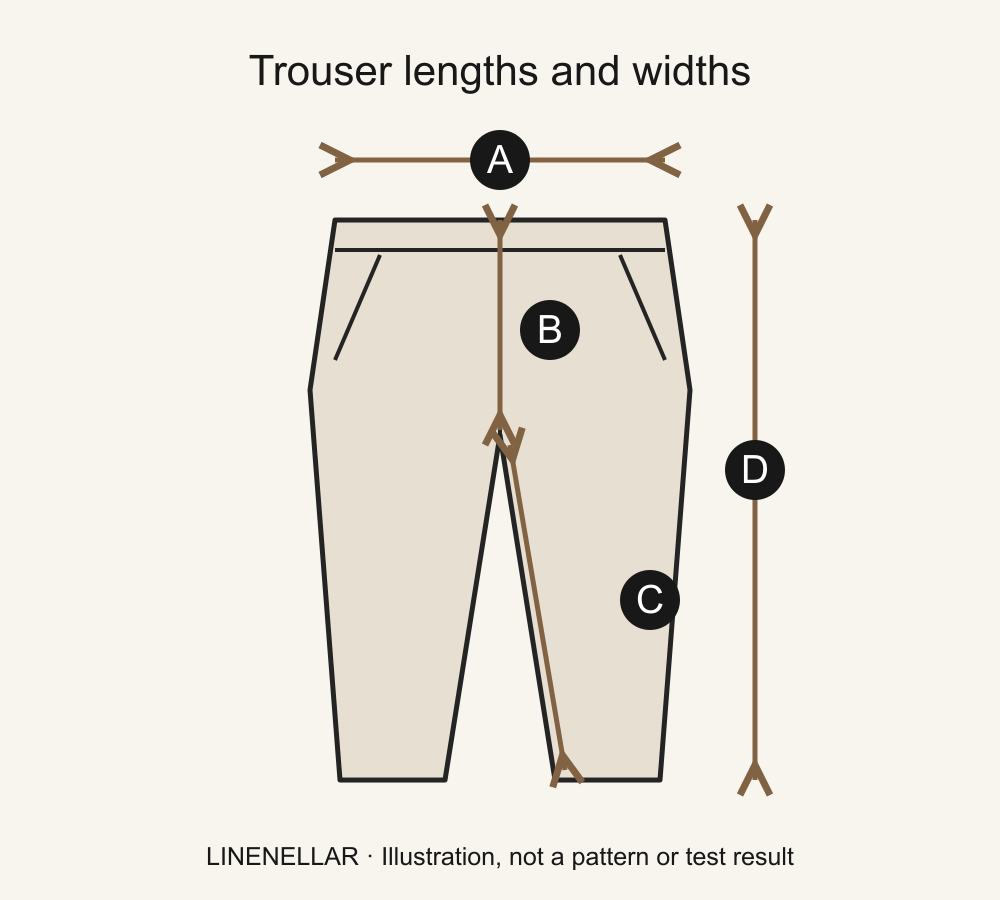
Take four distinct garment readings
- Waistband reference: record how the band is arranged. A relaxed elastic width is different from its stretched width. If a curved band cannot lie straight without pulling, keep the arrangement in a photograph or note instead of forcing a conversion.
- Front rise: follow the front crotch seam from the crotch-seam junction up to the top of the waistband, including the band in this method. Write “front rise, waistband included”. Back rise follows a different seam and must have its own label.
- Inseam: follow the inside leg from the crotch-seam junction to the inside hem. Do not start at the waistband or include an outside seam.
- Outside length: follow the side from the top of the waistband to the hem, again stating that the band is included. It is not interchangeable with inseam.
Keep the original readings even if a later comparison uses a converted figure. Doubling an elastic or shaped waistband’s flat width is not an exact body-waist calculation.
Select the hem in an outfit
Try the reference at the intended waistband height with the shoes you will use. Look at the front contact over the shoe and the back hem as well as the inseam number. A clean gap, light contact and a visible break are different preferences. A wider opening may fall differently over the same shoe.
If the hem is right but the upper trouser feels short, record the rise concern. Adding inseam alone does not describe that problem. If the waist is comfortable but sitting restricts the seat or thigh, keep those areas separate rather than asking for a larger waist.
Copy the trouser brief
Product and colour: ___
Body unit and readings: waistband-level waist ___; full seat ___; thigh ___ at ___
Waistband position: ___
Reference pair: front rise ___ including/excluding band; inseam ___; outside length ___
Reference fabric: woven non-stretch / stretch / unsure
Preferred leg line, shoes and hem: ___
Fit priority when sitting/walking: ___
Compare the Daily Men’s Straight-Leg Linen Trousers and Rest Men’s Linen Lounge Trousers. Use the custom service to agree the final proportions of the selected design.
Pieces to explore