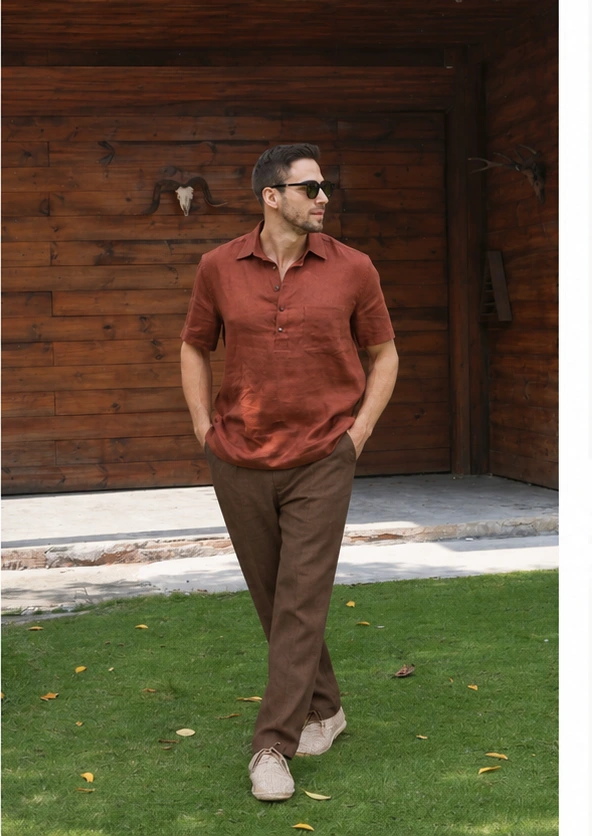

For a shorter man, linen trousers can feel disproportionately long or wide even when the waist is comfortable. Hemming may solve a simple length issue, but it does not automatically change the rise, knee position or leg opening. A custom brief should identify which proportions need attention and which parts of the original design you want to keep.
Two different reasons a trouser looks long
| Observation | Keep in the discussion | Check before changing |
|---|---|---|
| Waistband and knee position work; excess fabric gathers at the shoe | Preferred upper fit and lower-leg shape | Desired endpoint with your usual shoe |
| Hem is long and the taper/knee area also sits too low | The intended silhouette | Whether a proportion change is needed beyond hemming |
These observations do not diagnose the pattern. Provide a reference worn at the correct waistband level and describe which part you want to preserve. A shorter inseam with the same opening can give a different visual balance; do not shrink every dimension simply because you are shorter. Use the closest listed silhouette and ask the studio to confirm its custom proportions.
Start with the way you wear the waistband
Choose the intended waistband level before discussing the hem. Trousers worn lower can appear longer without a change to the garment itself. A waist measurement taken at another level also describes a different part of the body.
Tell the studio if you like the upper fit of a reference pair. If its rise feels too long or the waistband sits differently from the way you want, keep that issue separate from the lower-leg length. Height supplies context, but it is not a complete specification.
Choose the hem with ordinary shoes
Decide whether you prefer a clean line above the shoe, some contact at the front or a deliberately cropped appearance. A sandal, loafer and bulkier shoe can create different visual relationships. Try a reference pair with the shoe you actually intend to use.
Ask for the studio’s measuring method. An inseam and outside-leg reading are not interchangeable, and a measurement from an unfamiliar waistband position can be misleading. A named starting point is more helpful than asking for short length without a number or visual reference.
Keep the opening in proportion to the chosen leg
A wide opening and a straight opening make different silhouettes. If an existing pair feels both too long and too broad at the bottom, explain those as two observations. Reducing length alone may not produce the leg line you imagined.
Substantial tapering can also change how the trouser is designed to fall. Ask whether a different starting product is more appropriate than transforming one leg shape into another. The custom option needs to be read alongside the construction and the changes actually offered.
| Question | What to look at | What to send |
|---|---|---|
| Is the upper fit right? | Waistband level, seat and rise | Body measurements plus specific concerns |
| Is the leg too long? | Hem with intended shoe | Agreed inseam/outside-length method |
| Is the opening too broad? | Lower-leg line, not only the hem | Product/reference and preferred shape |
| Does a favourite pair help? | Similar woven construction | Separately labelled garment dimensions |
Think about knee and taper placement
The intended line can depend on where shaping occurs along the leg. Removing excess cloth only at the bottom does not move every other point. You do not need to prescribe the pattern alteration yourself; describe the disproportion and let the studio identify which measurements it needs.
Avoid a universal rule that shorter men must wear one rise or one opening. Comfort, shoes and personal style matter. A useful brief can preserve a relaxed linen appearance without making the garment close-fitting everywhere.
Pieces to explore