
A Linen Wardrobe for Retirement: Pieces for Your Everyday Plans
Retirement can change the balance of a wardrobe. Clothes once chosen for commuting and office meetings may have fewer outings, while daytime visits, personal projects or travel take up more space. That does not mean everything needs replacing. Before buying linen, look at what you actually wear across an ordinary week and what you wish felt more comfortable or more like you.
A useful wardrobe plan begins with activities rather than a prescribed number of pieces. Gardening, hosting lunch, visiting a gallery and attending a club dinner ask different things of clothing. Linen may have a place in several of those situations, but it does not need to become the answer to all of them.
Audit a real week, not an imagined lifestyle
For seven days, note the outfit you wore and the reason you chose it. Include the practical details: shoes, indoor temperature, sitting time and whether you changed later. An often-worn cardigan may tell you more about your daily needs than a saved photograph of a holiday outfit.
Then mark the friction points. Perhaps the trousers feel formal for home but you have no comfortable alternative for visitors. Perhaps a dress you love needs a layer you cannot find. Choose one gap to solve first. Buying a coordinated group without checking those gaps can produce an attractive wardrobe that still leaves the same everyday problem.
Give each proposed piece a job
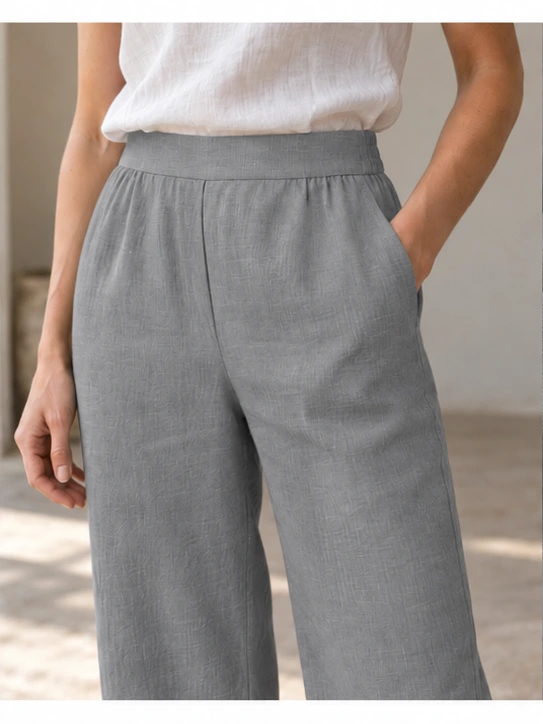
Think of three roles: a dependable bottom, a top that can alter the mood, and a single-piece outfit for days when you want fewer decisions. Those roles do not require purchasing all three. Existing jeans, a cotton shirt or a well-loved dress may already fill one perfectly.
For a linen bottom, decide how it will be worn at the waist and with which shoes. For a shirt, decide whether it must layer over another top or tuck into trousers. For a dress, consider whether its sleeve and neckline work without a second purchase. Defining the job exposes fit questions before you order.
Count outfits instead of counting garments
Suppose you are considering two shirts and one pair of trousers. Set each shirt beside the trousers and beside a bottom you already own. If all four combinations work with familiar footwear, the group has useful reach. If both shirts require the same special shoes you rarely wear, the apparent versatility may be less valuable in practice.
You can also build around a dress. Try it alone, with an existing cardigan and under an open shirt. Check the actual layers together: a full sleeve may feel crowded inside a narrow cardigan, while a long overshirt may hide a waist detail you enjoy. The aim is reliable combinations, not a theoretical capsule wardrobe.
Let maintenance influence the purchase
Retirement does not create a universal preference for low-maintenance clothing. Some people enjoy pressing a shirt; others prefer a natural, softly creased finish. Decide which approach suits you and consult the garment’s linen care instructions. Different constructions, trims and fabrics can require different treatment.
Do not buy a smaller size assuming the fabric will relax, or a larger size assuming you can shrink it at home. Fit and care should be discussed separately. If exact length matters, ask how the supplied garment and recommended care have been accounted for rather than experimenting after delivery.
Keep occasion clothing proportionate to your calendar
A retirement wardrobe can include polished pieces without returning to office dressing. One suitable outfit for dinners or family events may be enough if those events are occasional. If they are frequent, a second direction could be worthwhile: for example, a dress for one setting and shirt with trousers for another.
Think about the environments as well as the invitations. A long lunch involves sitting; an outdoor celebration may involve uneven ground; a theatre visit may need an extra layer. Make those conditions part of the outfit brief. A garment that looks right while standing may still need a different rise, hem or sleeve arrangement for its intended use.
Buy in stages and learn from the first piece
Start with the gap that matters most. Wear the first purchase in ordinary life before ordering a larger group. Notice whether the chosen shade combines as expected, whether the pockets are useful and whether the length suits your shoes. Those observations make the next order more precise.
LINENELLAR’s standard and custom routes let you start from a listed design. Custom adds 20% to the selected product price; one optional note can describe fit preferences, with details confirmed before making. You do not need to supply a complicated tailoring specification to begin the conversation.
A successful retirement wardrobe supports the life you are living, including work or volunteering if those remain part of it. Keep the clothes that still serve you, add selectively, and judge the result by how easily you get dressed for your own plans.
Continue reading
Pieces to explore
Three designs to compare with the ideas in this article. Open each product for current pricing, available choices and construction details; confirm any requested fit or design change with our studio.
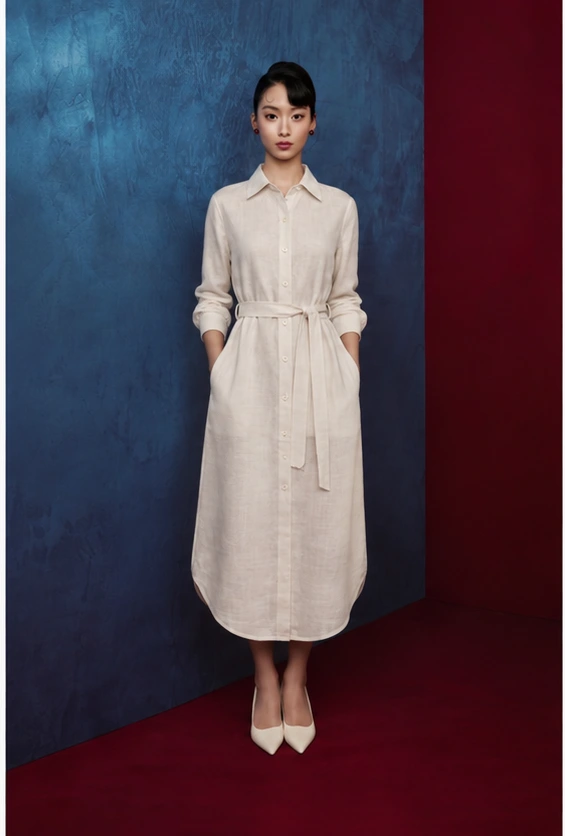
Linen Outfits for Mature Women Who Prefer a Defined Waist
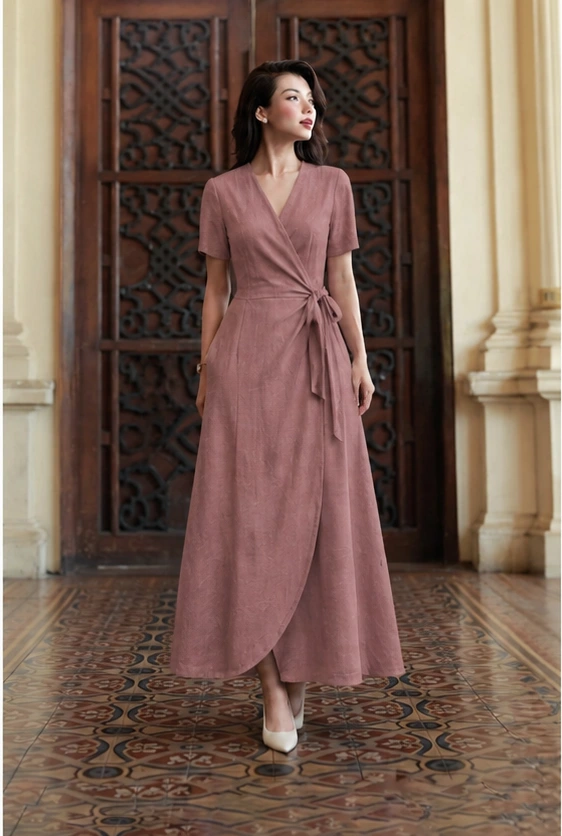
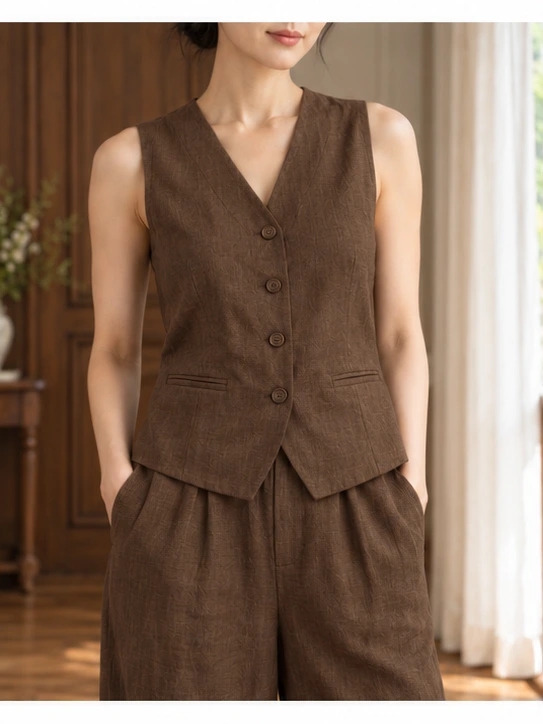
If you enjoy seeing a waist in your outfit, linen gives you several directions to explore: a wrap dress, a shaped waistcoat, a tucked shirt or a dress with a belt. The important distinction is between definition you like looking at and pressure you dislike wearing. A waist can be visible without being tightly compressed.
This is a style preference, not an instruction for mature women to dress in a particular way. Start by deciding how much definition you want and where you want it to appear. The smallest point of the torso, the position of a trouser waistband and the preferred visual waist may not be the same place.
Separate placement from circumference
When a belt feels wrong, tightening it is not always the answer. It may sit above or below your preferred position, or pull extra fabric into the front while leaving the back uneven. Before changing size, notice the location of the shaping and whether the garment length supports it.
Try a belt you already own over a loose dress at slightly different heights. This is an observation exercise, not a pattern adjustment. Photograph the front and side if useful, then record which position feels natural sitting as well as standing. Explain that preference to the studio and ask whether the chosen design can accommodate it.

Compare three ways to create definition
A wrap design uses its overlap and fastening to shape the waist. Check the neckline and skirt overlap during movement, not only the tie. A shaped waistcoat builds definition through its cut; it still needs enough room through the bust and upper back. A tucked shirt relies partly on the trouser waistband and partly on the amount of shirt fabric being tucked.
These approaches produce different sensations. If you dislike a belt around the middle, a shaped garment may be more appealing than tying a loose dress tightly. If you like adjusting an outfit through the day, a removable belt may suit you. Do not assume that every tie-waist design offers unlimited adjustment or that all waistcoats have the same internal structure.
Check the outfit from the side and while seated
A waist-defined outfit can look balanced from the front while feeling crowded at the lap. Sit in your usual chair with the outfit fastened as intended. Notice whether the waistband folds, the shirt pulls out or a wrap skirt opens more than you expect. Those are useful fit observations, not evidence that your body is the problem.
For online ordering, describe the situation: “I like a shaped waist standing, but I do not want the waistband pressing when seated for lunch.” A studio may need body measurements, a reference garment or further questions to resolve it. There is no reliable universal extra number of centimetres that suits every design and wearer.
Balance the top and bottom deliberately
If both pieces contain volume, decide which one supplies the waist line. A full shirt tucked into wide trousers can work, but the amount of fabric at the waistband matters. Try the combination with the underwear and shoes you expect to wear. A different top length or a less bulky tuck may change the result without making the whole outfit narrower.
If the dress already has a strong waist detail, a layer can either reveal or soften it. A short open jacket may keep the waist visible; a longer unfastened shirt creates another line over it. There is no need to follow a rule that a cardigan must end at one exact point. Look for the effect you prefer and test whether the layers feel comfortable together.
Use colour to support, rather than replace, fit
A similar shade above and below the waist can make two pieces read as a connected outfit. Contrast can emphasise their division. Neither will correct a waistband that is uncomfortable or a bodice that pulls. Resolve the physical fit first, then use the 27-shade library to compare the visual effect.
If coordinating separate orders, ask about matching expectations rather than assuming photographs guarantee identical fabric appearance. Lighting and screens affect how colours look, and the studio should confirm the selected material. Your brief can include which existing shoes, bag or layer you want the outfit to work with.
A concise custom brief
Write four things: the listed design you like, where you prefer the waist to sit, the activity that needs comfort, and the reference garment you can compare. For example: “I prefer the waist position on my favourite dress, with enough room to sit comfortably. Please confirm how to measure that dress.” This is clearer than asking for an hourglass effect without explaining the fit.
The Bloom Linen Wrap Dress and the waistcoat directions below offer different starting points. LINENELLAR’s made-to-measure option adds 20% to the selected product price, and design requests need confirmation. The goal is a shape you enjoy throughout the day, with the degree of definition you have chosen for yourself.
Continue reading
Pieces to explore
Three designs to compare with the ideas in this article. Open each product for current pricing, available choices and construction details; confirm any requested fit or design change with our studio.
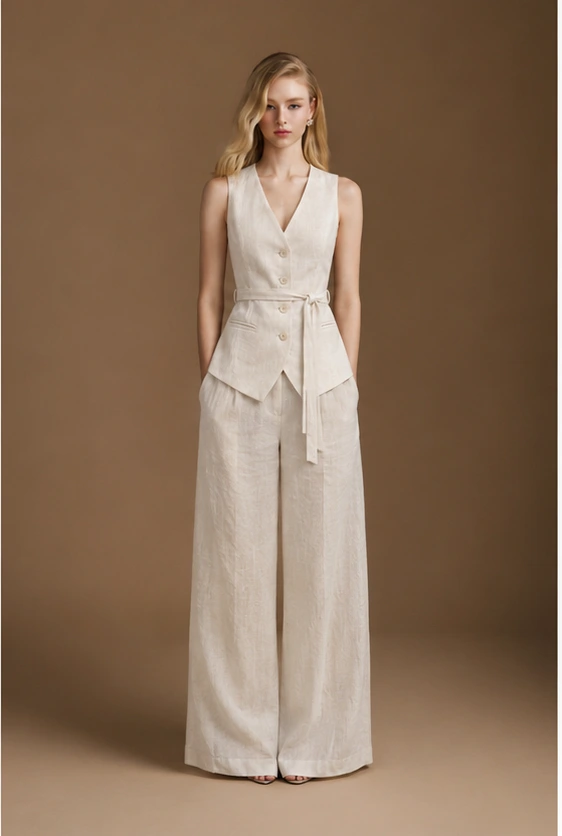
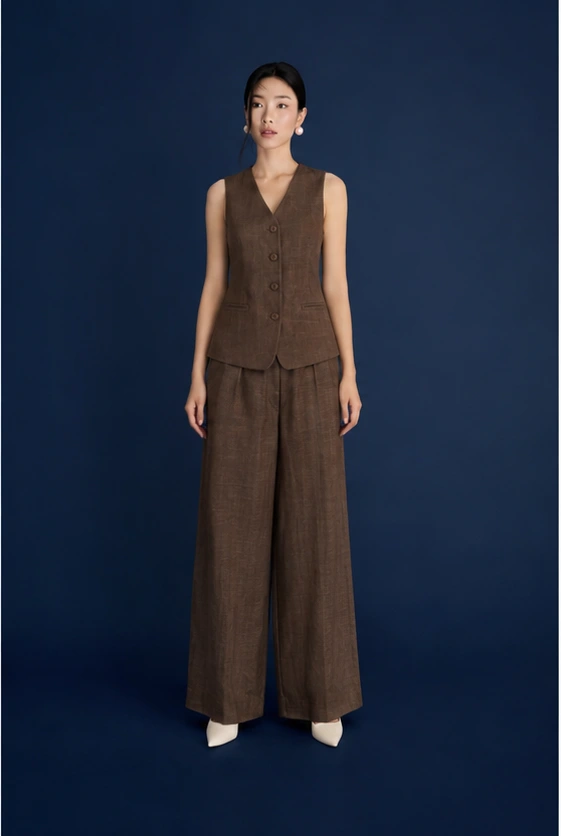
Ordering Custom Linen When Your Top and Bottom Sizes Differ
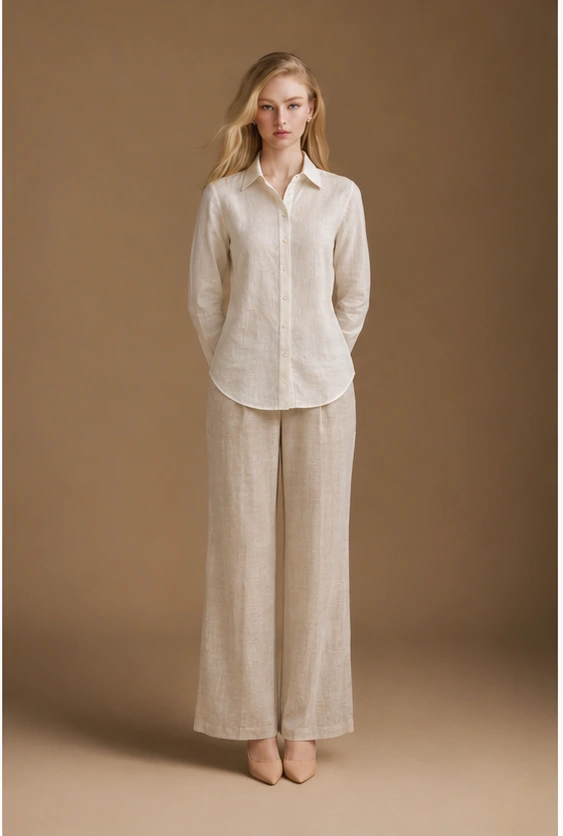
If your preferred top size differs from your preferred trouser size, that is useful ordering information rather than a problem to conceal. Size labels are a retailer’s grouping system, and a single label does not describe every proportion of the body. The important task is to make each garment fit its intended area and work with the other pieces in the outfit.
This matters particularly when considering a coordinated set. A photograph may show a complete look, but it does not tell you how the retailer handles different top and bottom requirements. Ask before ordering rather than assuming one selected size can represent both comfortably.
Separate the two fit decisions
For the top, identify the priorities: shoulder position, upper-back room, bust or chest room, sleeve and finished length. For the bottom, consider waistband position, hip or seat room, rise, leg shape and hem. Keep those observations distinct even if the garments will be worn together.
Then consider the relationship between them. A top worn untucked needs a length that works with the bottom’s rise; a tucked top needs comfortable room at the waistband. If the pieces are intended to be worn separately too, describe those uses. A set should not only work in the single arrangement shown in its first photograph.
Check the guide before transferring familiar labels
An M from one brand may not correspond to an M from another. Read the LINENELLAR size guide and identify what its measurements describe. If anything is unclear, ask rather than silently treating a body-measurement reference as finished garment dimensions.
Do not average two preferred sizes into one compromise size. That can make one garment larger than needed while leaving the other restrictive. Instead, ask which standard selections are available for separate pieces or how a custom set should be specified. The studio should confirm the actual ordering arrangement for the chosen product.
Use two reference garments if useful
Choose a comfortable top and a comfortable bottom with purposes reasonably similar to the intended purchase. A stretchy legging and a woven linen trouser are not direct fit equivalents. Likewise, a close knitted top does not demonstrate the same room requirements as a woven shirt.
Ask how to measure each reference and label the figures clearly. State units and whether the measurement is a flat width, a circumference or a finished length. A list containing “waist 42” is not enough if the unit and source are unknown. Keep body measurements separate from garment measurements throughout the conversation.
Describe where standard sizes usually disagree
You may find that shirts fit the shoulders but pull across the bust, or that trousers fit the waist but not the hips. Explain that relationship rather than assuming the studio will infer it from two size labels. The recurring issue can help identify which information needs closer review.
For example: “I usually choose a larger top than bottom. My reference shirt has comfortable upper-back room, while these trousers sit at the waist position I prefer. I would like the set to retain a relaxed outline.” This communicates the difference without prescribing a technical pattern solution or adding guessed ease to body numbers.
Confirm the set’s scope before paying
Ask whether the listed product can be supplied with the top and bottom proportions you need, and whether a particular request falls within custom fit or requires a separate design discussion. A custom option is not an automatic promise that every construction detail can be changed.
Also confirm which shade and material apply to each piece. Coordinated outfits should be agreed deliberately; do not assume matching colour names from separate images establish an exact fabric match. If the set is important for an event, discuss that expectation and leave time to assess it after delivery.
Keep fit notes attached to the right garment
When sending information for a set, use clear labels such as “Top” and “Trousers” within the note. If ordering separate products, put the relevant information with the relevant item and check the order summary. Do not rely on a general comment that could be interpreted as applying to every garment in the basket.
LINENELLAR’s made-to-measure route adds 20% to the selected product price. Its note box is optional and the studio confirms details before making. You can begin with the sizing difference and ask for guidance rather than supplying a complete technical specification at checkout.
Judge the result as separate pieces and as an outfit
When the order arrives, try each garment with the intended underlayers and shoes, then try them together. Sit and move normally. Check whether the top and bottom retain their own comfortable fit when combined, including any tuck or belt you planned.
Review the returns and alterations information before ordering and raise any issue against the agreed brief. A genuinely personalised order and a standard-size order may be treated differently, so clarify that in advance. The goal is two pieces that serve you individually, not a single size label that forces both into the same proportions.
Continue reading
Pieces to explore
Three designs to compare with the ideas in this article. Open each product for current pricing, available choices and construction details; confirm any requested fit or design change with our studio.
How to Describe a Comfortable Fit Without Knowing Tailoring Terms
You do not need tailoring vocabulary to begin a useful fit conversation. “The sleeve grips when I bend my elbow” can be more informative than using a technical term incorrectly. A clear description tells the studio what you experience, when it happens and what kind of outline you still want.
This is especially helpful when ordering linen online, where a photograph cannot show every aspect of movement and comfort. Your role is to explain your preferences accurately. The studio’s role is to confirm the information and assess what can be done within the chosen design.
Start with four ordinary questions
Name the garment you are discussing. Describe the activity that matters. Explain what feels wrong in a comparable piece. Then say what you want to preserve. These four points keep the brief specific without turning it into a long technical document.
For example: “I like this shirt’s relaxed outline. My current woven shirt pulls across my back when I reach towards a table. I would like easier movement without a much wider body.” This separates appearance from function and gives the studio a reason to ask targeted follow-up questions.

Replace vague adjectives with situations
Comfortable, flattering, loose and modest are useful starting words, but people interpret them differently. Add the situation that gives the word meaning. Comfortable might mean sitting through lunch without waistband pressure. Loose might mean room around the waist while keeping a fairly clean shoulder line.
Coverage preferences can be explained in the same way: “I would like the neckline to feel secure when leaning forward,” or “I prefer the hem to cover my knee when seated.” These are desired outcomes, not guarantees that every listed design can achieve them. Ask which design is an appropriate starting point.
Describe a sensation without diagnosing the pattern
You can report pulling, pressure, slipping, bunching or the need to readjust. You do not need to decide that the armhole is too low or the rise must increase by a certain amount. Several design factors may contribute to one experience, and a photograph alone may not identify the cause.
Use a normal activity rather than an exaggerated pose. If the shirt is for everyday wear, show or describe ordinary reaching and sitting. If the trousers are for travel, explain that use. This helps keep the assessment connected to the garment’s real job instead of an abstract ideal fit.
Tell the studio what already works
An existing garment can provide positive information as well as a complaint. You may like its shoulder position, sleeve length or waistband height even if another part is wrong. Identify those details so the request does not become “make everything bigger” or “make everything smaller.”
If a reference is useful, ask how to measure it. Label the figures as garment measurements and keep them separate from body measurements. Do not stretch a garment flat to create a desired number or add guessed room to body figures. The studio needs to know what each measurement represents before using it.
Include the outfit context
Say whether the shirt will be tucked, untucked or layered over another top. Mention the shoes intended for trousers and any outer layer that must fit over sleeves. These details can influence length and room in ways that a body measurement alone does not express.
You can keep this concise: “Untucked, over a light sleeveless top, usually with flat shoes” may be enough to begin. If a fixed occasion matters, give the date as a timing question rather than assuming the order is automatically accepted for that deadline. Ask about feasibility before making is confirmed.
Use photographs selectively and respectfully
A reference photograph can show a hem position or an outline you enjoy, but it should not be treated as a complete specification. Explain which detail matters rather than asking to copy an entire image. Choose images you are comfortable sharing, and do not send private medical information simply to explain an ordinary clothing preference.
If the studio asks for a particular view or measuring image, follow that request and keep the purpose clear. Avoid sending many unrelated inspiration pictures that contradict one another. A small set of labelled references is easier to interpret than a large folder with no explanation.
A plain-language note you can adapt
Use this structure: “I am interested in [listed design]. I will wear it for [ordinary activity] with [relevant layer or shoes]. I like [shape or detail]. In my current garment, [specific experience]. Please confirm what information you need and whether this design is suitable.” Replace each part with your own facts rather than copying someone else’s measurements.
LINENELLAR provides one optional measurements-and-requests box for made to measure, at a 20% surcharge on the selected product price. You can leave it blank and discuss details before making. If you do write a note, plain language is welcome; clarity matters more than terminology.
Before confirmation, read back the agreed design, fit priorities and any accepted adjustments. Ask if something remains unclear. A useful brief is a shared understanding of what is being made, not a test of how much tailoring language you know.
Continue reading
Pieces to explore
Three designs to compare with the ideas in this article. Open each product for current pricing, available choices and construction details; confirm any requested fit or design change with our studio.
Men’s Linen Trousers with Flat-Front or Relaxed Styling: Which Direction Suits You?
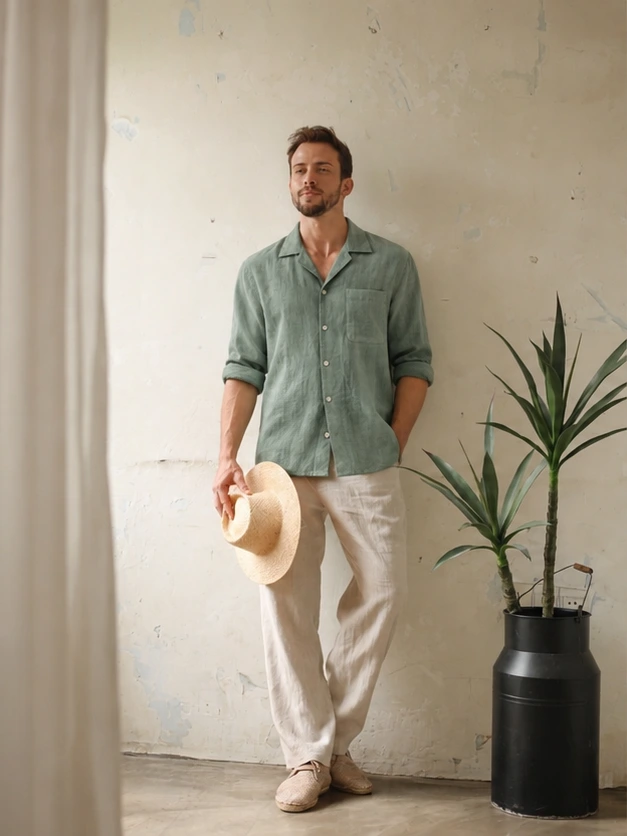
Flat-front and relaxed are not opposite technical categories. Flat-front describes a construction or styling feature at the front, while relaxed often describes the overall fit or mood. A pair of trousers can have a flat front and still offer a generous silhouette. Understanding that distinction makes online comparisons more useful.
Rather than choosing between two vague labels, decide what you want from the waistband, seat, leg and finished length. Men looking for comfortable linen trousers often need those proportions considered separately. A photograph or product name cannot establish the complete wearing experience.
Define the outline you want to see
A cleaner trouser line may have less visual volume through the leg, while a fuller direction allows more fabric to fall below the waist. Neither is automatically more polished or more comfortable. The result depends on the pattern, fabric and how the garment fits your own body.
Look at a pair you already enjoy and identify the part that works: perhaps a straight leg, a particular waistband position or room around the thigh. Then identify what you want to change. “Keep this leg direction but discuss seated comfort” is a stronger brief than “make it relaxed,” which could be interpreted in several ways.
Read the actual waistband and fastening details
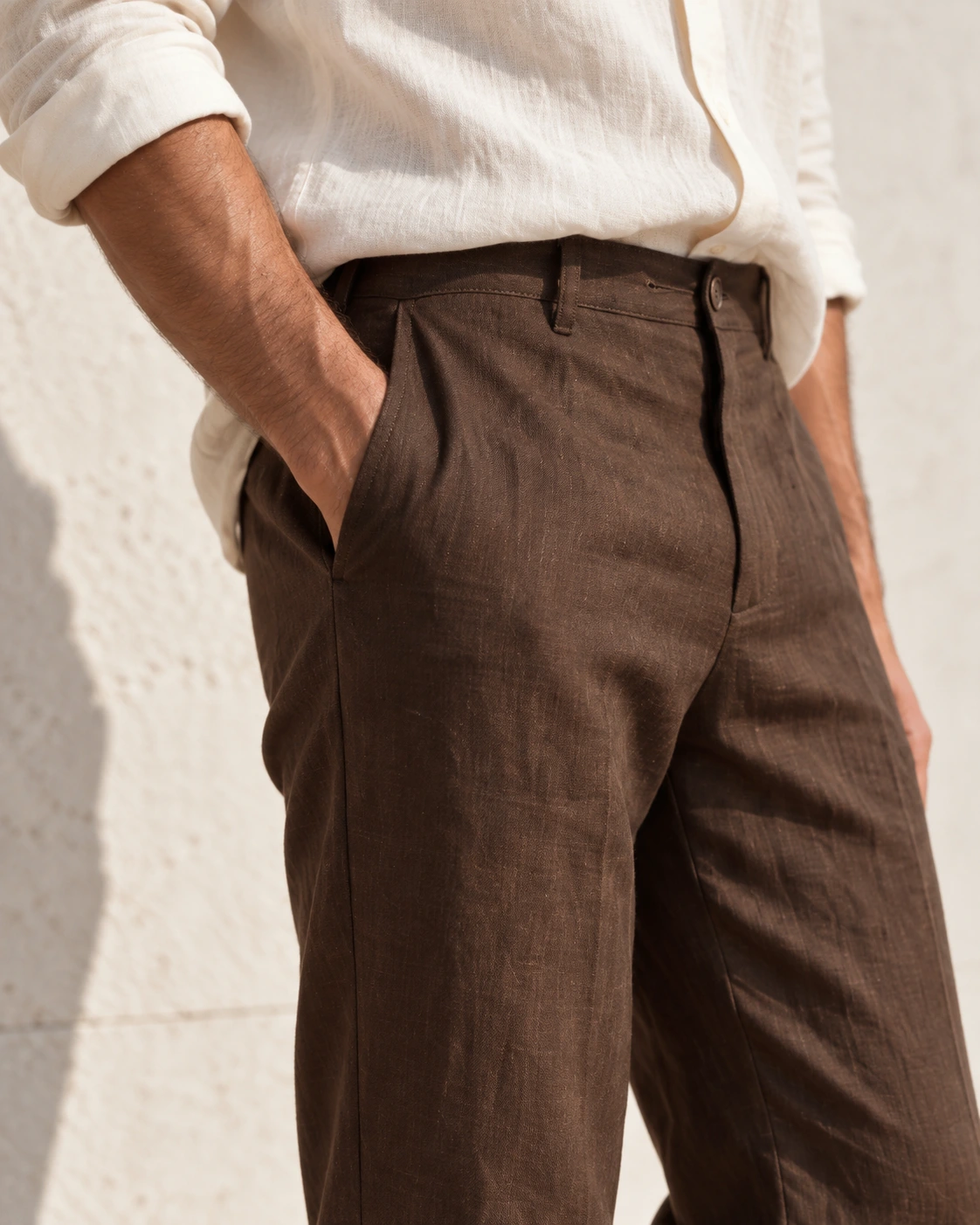
Do not infer elastic, drawstrings or stretch from a casual-looking image or the word ease. Check the selected product’s construction. A fixed waistband, a partially elastic arrangement and another fastening system each need to be assessed on their own terms.
Decide whether you want to use a belt and where you like the waistband to sit. If a belt is needed only to hold an oversized waist in place, ask whether another proportion would work better. Adding width at the waist may not solve a restriction through the seat, and tightening a belt may create a different comfort issue.
Check sitting before deciding the fit is right
Sit in the reference trousers with the waistband at the intended position. Notice pressure at the front, pulling through the rise and room across the hips. Stand and walk again. A trouser can look neat standing yet feel restrictive at lunch, while a fuller leg does not automatically prevent that problem.
Describe the location and activity to the studio rather than prescribing a universal allowance. If measurements are requested, distinguish body figures from flat garment measurements. Do not add extra room to body numbers without agreeing the method, because the pattern may already include design-specific ease.
Choose leg width with the shoes in mind
Try the intended shoes with a comparable trouser shape. A substantial loafer or walking shoe may change the effect of a hem compared with a slim sandal. Decide whether you like a cleaner break or a softer meeting of fabric and shoe, then check practical clearance from the ground.
If alternating footwear, test both. One length may work for several shoes, or you may prefer trousers with a more specific role. Do not assume the inseam from a different trouser design will create the same result; rise and waistband position influence where the finished hem sits.
Consider how the shirt will be worn
Tucked and untucked shirts place different emphasis on the waistband and upper trouser shape. If you usually leave shirts out, look at how their hem meets the trousers. If you tuck, assess the amount of fabric at the waist and whether it remains comfortable sitting.
A jacket or overshirt can change the outfit’s mood, but should be tried with the actual trouser proportions. There is no age-based requirement to choose a narrow leg or a loose one. Choose the outline you enjoy, then make sure the other pieces support it rather than relying on a style label to do the work.
Use product comparisons as questions, not guarantees
The Daily Men’s Straight-Leg Linen Trousers, City Men’s Tailored Linen Trousers and Ease Men’s Linen Trousers offer directions to investigate. Read each description and confirm the details that matter. Their names should not be treated as proof of identical waistbands, rises or allowances.
Ask which design is closest to the combination you want: a cleaner front, comfortable seated room and your preferred leg width. Substantial design changes may need separate review. It can be more effective to start with a suitable listed pattern than to request several unconfirmed alterations to another one.
Confirm before making
LINENELLAR offers standard options and made to measure at a 20% surcharge on the selected product price. One optional note can explain your fit priorities, and the studio confirms details before production. Review the care guidance rather than planning to shrink or stretch the delivered trousers into shape.
The right direction is the one that works with your waist position, movement, shoes and shirt. Treat flat-front and relaxed as starting descriptions, then make the actual fit and construction the basis of the decision.
Continue reading
Pieces to explore
Three designs to compare with the ideas in this article. Open each product for current pricing, available choices and construction details; confirm any requested fit or design change with our studio.

A Linen Shirt and Trousers for a Mature Couple’s Holiday
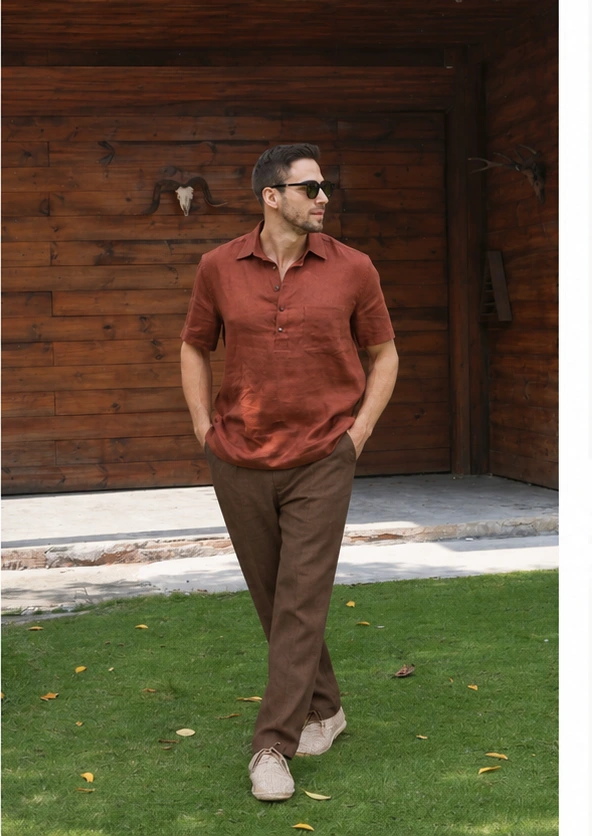
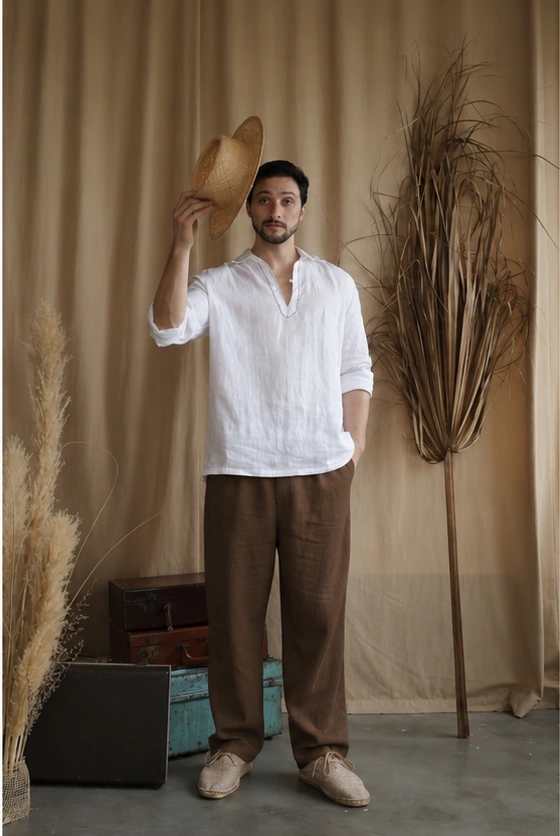
Choosing holiday clothes together can be enjoyable without turning into a matching-outfit project. A linen shirt and trousers for each person might connect through a palette, a relaxed mood or simply suitability for the trip. Each wearer still needs an individual fit, preferred coverage and a way of dressing that feels natural.
For a mature couple, the useful shared decisions are often practical: itinerary, luggage, laundry and the activities planned. Start there. Do not assume both people want the same level of formality, the same sleeve length or the same silhouette just because the clothes will appear together in photographs.
Plan the holiday before planning the palette
List the main activities and settings: travel days, walking, meals, visits and evenings. Check venue and local visitor requirements from the relevant official information when needed. A holiday label does not make every linen outfit suitable for every restaurant, site or climate.
Then decide which existing clothes and shoes are coming. Build around those rather than buying an entire coordinated wardrobe at once. If one person prefers dresses and the other prefers trousers, the outfits can still relate without requiring identical garment types or matching sets.
Give each person an independent fit brief
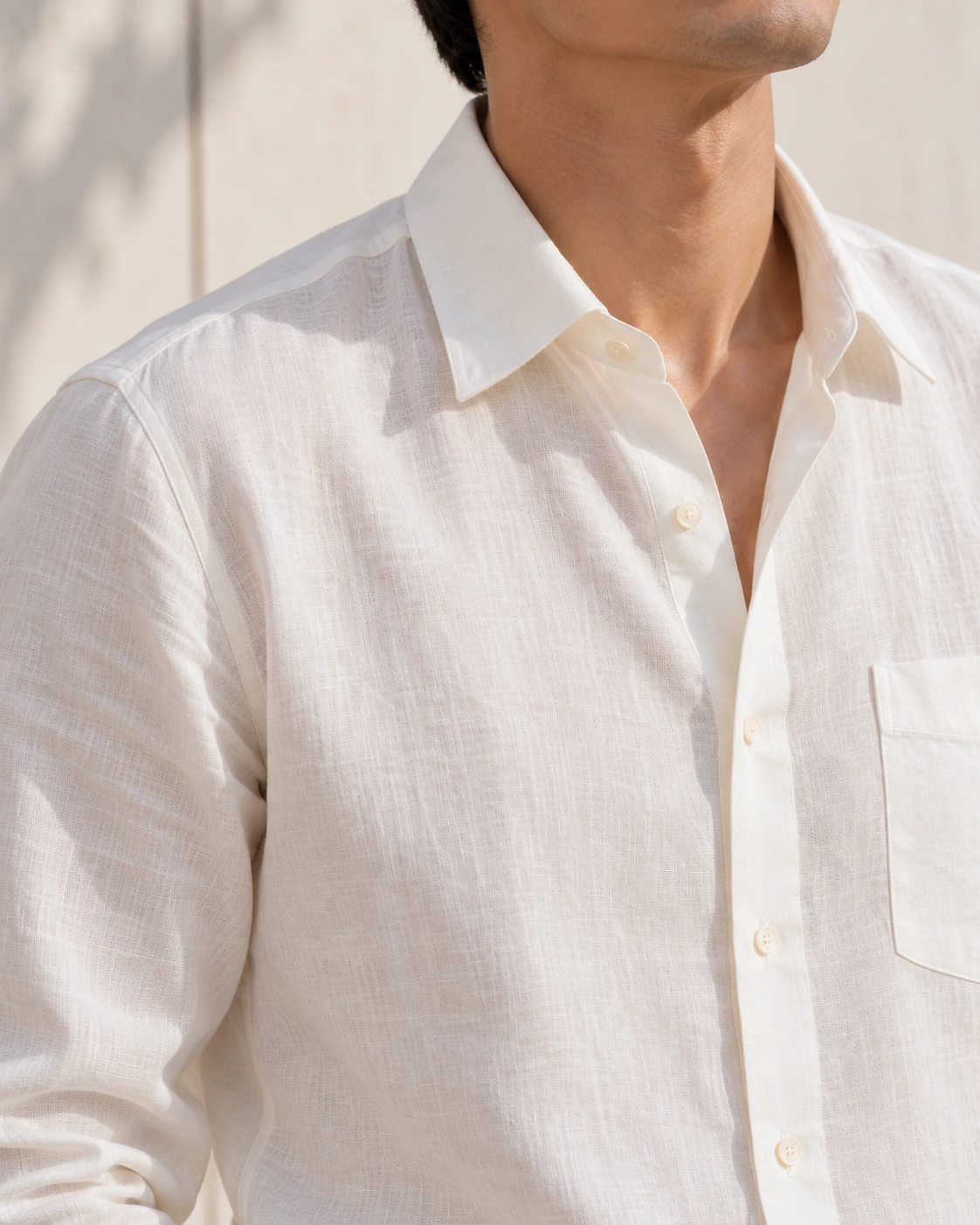
One person may prioritise upper-arm room, another trouser rise, and another shirt length when worn untucked. Record these separately. A shared order should not collapse two sets of preferences into one general request for loose holiday clothing.
Use comfortable reference garments where useful, clearly labelled as garment measurements. Ask the studio for its method before providing a list of numbers. Body and garment measurements are different, and two people of similar height may still need different finished lengths or waist positions. Fit should be confirmed for each wearer.
Coordinate by relationship rather than duplication
Choose a small group of shades that works with the shoes and layers you already own. One person might wear a familiar neutral while the other introduces a stronger shade. A repeated colour in a bag or shirt can connect the outfits without making them identical.
Use the linen library to compare directions, but do not assume screen images provide exact colour matching. If coordinated fabric is important, explain that to the studio and ask for confirmation of the selected options. The aim can also be a deliberate contrast, which may be easier to enjoy than an uncertain near-match.
Make each garment work in more than one complete outfit
For each proposed shirt, identify at least two bottoms or uses already in the packing plan. For each trouser, identify the tops and shoes it will meet. This is an exercise in practical compatibility, not a demand that every garment suit every occasion.
Try the combinations together before departure. Check seated comfort for meals, hem clearance with walking shoes and sleeve room under the intended layer. If a shirt is planned both open and closed, test both. A packing list is only as useful as the outfits it can actually produce.
Agree how care will work while away
Read the care instructions for the selected garments and check any planned laundry service before relying on it. Do not assume that two linen pieces require the same process or that a hotel service will automatically follow the supplied guidance.
If a pressed finish matters for a particular dinner, plan how to achieve it safely within the accommodation’s rules. If you enjoy a natural creased appearance, that may reduce the importance of pressing, but it does not remove the need for appropriate washing and drying. Keep care preferences individual too; one person may enjoy a finish the other does not.
Keep shared ordering practical rather than pressured
LINENELLAR’s retail shipping policy offers free standard shipping on orders with two or more physical items. That can be useful for a genuine shared order, but it is not a reason for either person to buy a garment they do not want. Check destination details and other applicable delivery terms before paying.
For made to measure, the surcharge is 20% of the selected product price. Notes can be left blank and details are confirmed before making. Allow separately for confirmation, making, delivery and a full try-on before departure; do not treat the holiday date as something an estimate automatically guarantees.
The suggestions below are pieces to discuss individually, then combine with your own holiday wardrobe. A good couple’s plan leaves both people feeling comfortable and recognisable, with enough coordination to make packing easier and enough independence to keep the clothes personal.
Continue reading
Pieces to explore
Three designs to compare with the ideas in this article. Open each product for current pricing, available choices and construction details; confirm any requested fit or design change with our studio.
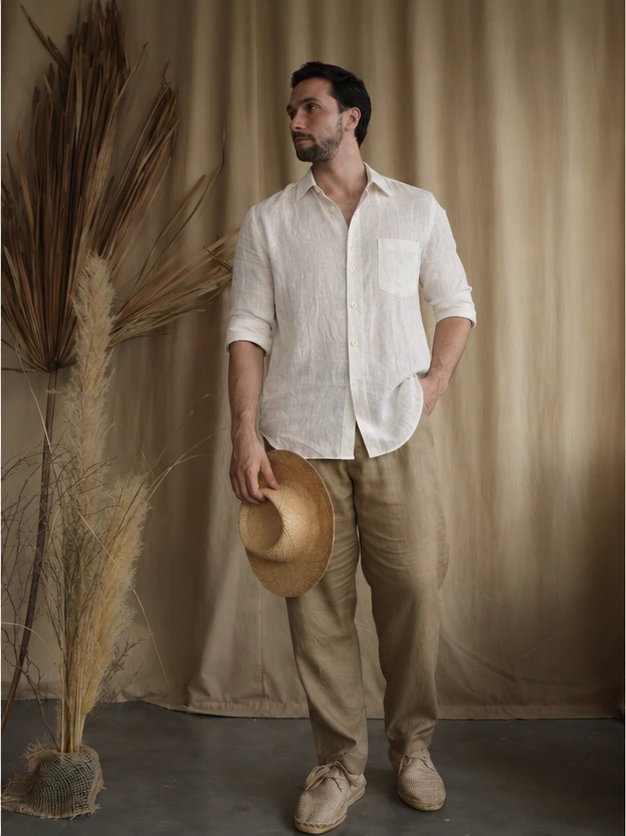
Linen for a Retired Man’s Wardrobe: Comfortable Pieces That Still Feel Polished
Retirement may reduce the need for office clothes, but it does not remove the pleasure of looking well dressed. A linen shirt or pair of trousers can offer a different direction for daytime plans, visits and meals out. The useful starting point is what your week now contains, not a ready-made picture of how a retired man should dress.
Keep the pieces that still work. A favourite jacket, familiar walking shoes or well-fitting trousers can form the basis of new combinations. The aim is to make the wardrobe more useful, not to replace an old identity with a complete new set of leisure clothes.
Observe a normal week before buying
Note what you wear for errands, time at home, social plans and any work or volunteering you still do. Identify the moments when the wardrobe feels least suitable. Perhaps a formal shirt feels unnecessary for lunch, or casual trousers do not work with the jacket you enjoy wearing.
Choose one gap to solve first. If most days involve relaxed separates, a useful shirt may have more value than another occasion jacket. If social dinners are frequent, a trouser that works with several existing tops may be the stronger purchase. The calendar should determine the priorities, not a generic capsule-wardrobe number.
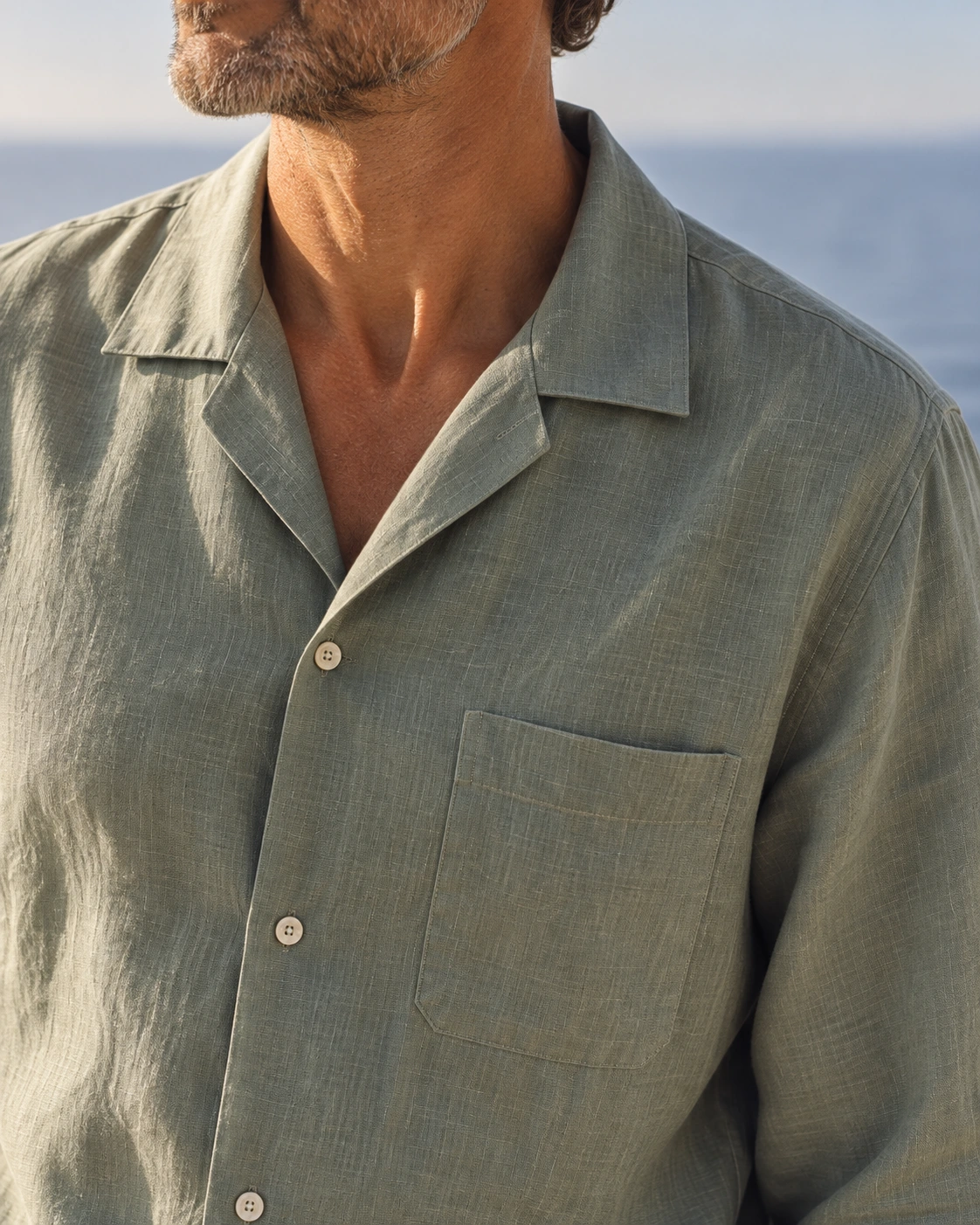
Define what polished means to you
For some men, it means a collar and a clean trouser line. For others, it means coordinated colour, a well-chosen shoe or an overshirt that finishes a simple outfit. You do not need a narrow fit to look considered, and a relaxed outline does not have to look accidental.
Look at an outfit you already enjoy and identify the detail that creates that feeling. Then preserve it while changing the part that no longer suits your routine. For example, you might keep a familiar shoe and trouser shape but choose a shirt direction you prefer wearing untucked.
Fit the shirt for its actual use
Decide whether the shirt will be tucked, untucked or worn as a layer. These uses affect the length and room you need. Check upper-back movement and sleeve comfort in a comparable woven shirt, and explain any recurring restriction to the studio rather than simply ordering a larger size.
An untucked shirt should relate to the trouser rise and your torso length. A layered shirt needs to accommodate the top underneath. If you expect both uses, say so. Do not ask for extra width everywhere without distinguishing the room you need from the silhouette you want to see.
Make trousers work for sitting as well as standing
Visits, travel and meals often involve extended time seated. Check waistband position, rise and seat room with a reference pair. Notice whether you repeatedly adjust a belt or pull the waistband after standing. Those observations can guide a more useful fit discussion than a size label you have always bought.
Choose the hem with your usual shoes. If the trousers will alternate between loafers and walking shoes, try both before confirming a custom length. A fuller leg and a straight leg can each work, but the relationship with the shoe and the ground needs practical attention.
Build three outfits from one addition
Before buying a linen shirt, identify three realistic combinations: perhaps with familiar trousers for a visit, with shorts for an appropriate daytime setting, and under an existing jacket for dinner. Check the venue’s expectations where relevant; linen does not automatically meet every dress code.
If the proposed piece only works with several other unpurchased items, decide whether that wider purchase is actually wanted. A smaller addition with clear partners often gives a better view of what you like about linen before committing to more. It also preserves the useful clothes already in the wardrobe.
Match maintenance to your routine
Decide whether you enjoy a pressed finish or a more natural appearance, then follow the garment’s care guidance. Do not assume all linen clothing can be washed and dried identically. Construction and details matter alongside the fibre label.
If fit is uncertain, do not plan to shrink or stretch the delivered garment into place. Resolve the questions before ordering. LINENELLAR offers standard options and made to measure at a 20% surcharge on the selected product price, with one optional note and confirmation before making.
The pieces below give several starting directions, not a uniform for retirement. Choose a role, establish comfortable proportions and wear the first purchase in ordinary life. The best guide to the next addition will be the one you repeatedly reach for and the reason you enjoy it.
Continue reading
Pieces to explore
Three designs to compare with the ideas in this article. Open each product for current pricing, available choices and construction details; confirm any requested fit or design change with our studio.

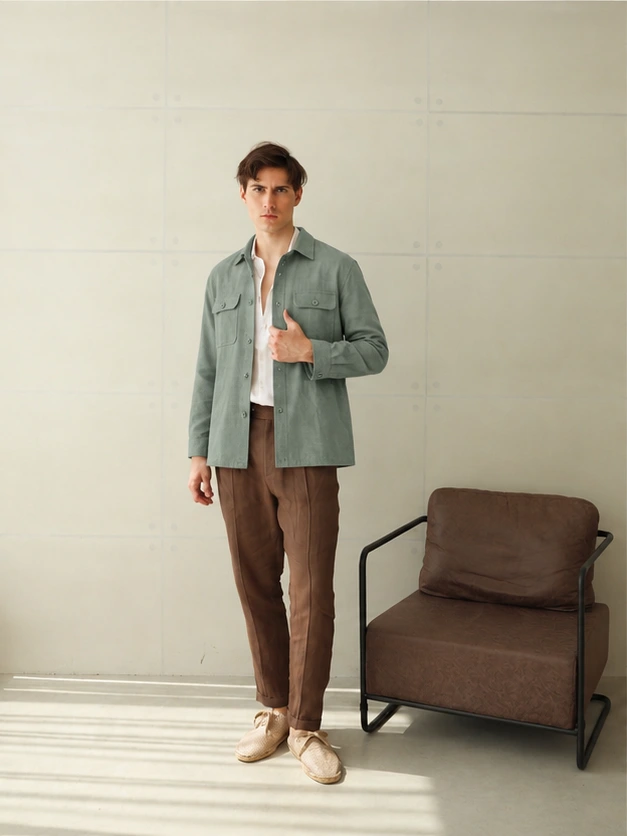
Linen for a Relaxed Wedding: What the Mother of the Bride or Groom Should Consider
For the mother of the bride or groom, choosing an outfit can involve more than personal preference. You may want to coordinate with the couple, feel appropriate beside other family members and remain comfortable through a long day. Linen can be a direction for a relaxed wedding, but only after the event’s expectations have been clarified.
There is no universal rule that mothers should wear a particular silhouette, colour or level of coverage. The strongest starting point is a conversation with the couple, followed by a clear view of the venue and schedule. An outfit should feel like you while respecting the celebration they are planning.
Confirm formality and colour expectations first
Ask what “relaxed” means for this wedding. It could describe the atmosphere while the clothing expectations remain quite polished. Check the invitation and ask the couple about any colour preferences or exclusions. Do not assume a pale shade is acceptable, or that it is prohibited, without that context.
If coordinating with another parent or the wedding party, aim for an agreed direction rather than making an exact match from screen photographs. Ask how much coordination is actually desired. A clear contrast may be easier than an uncertain near-match, and the couple may prefer individuality over uniformity.
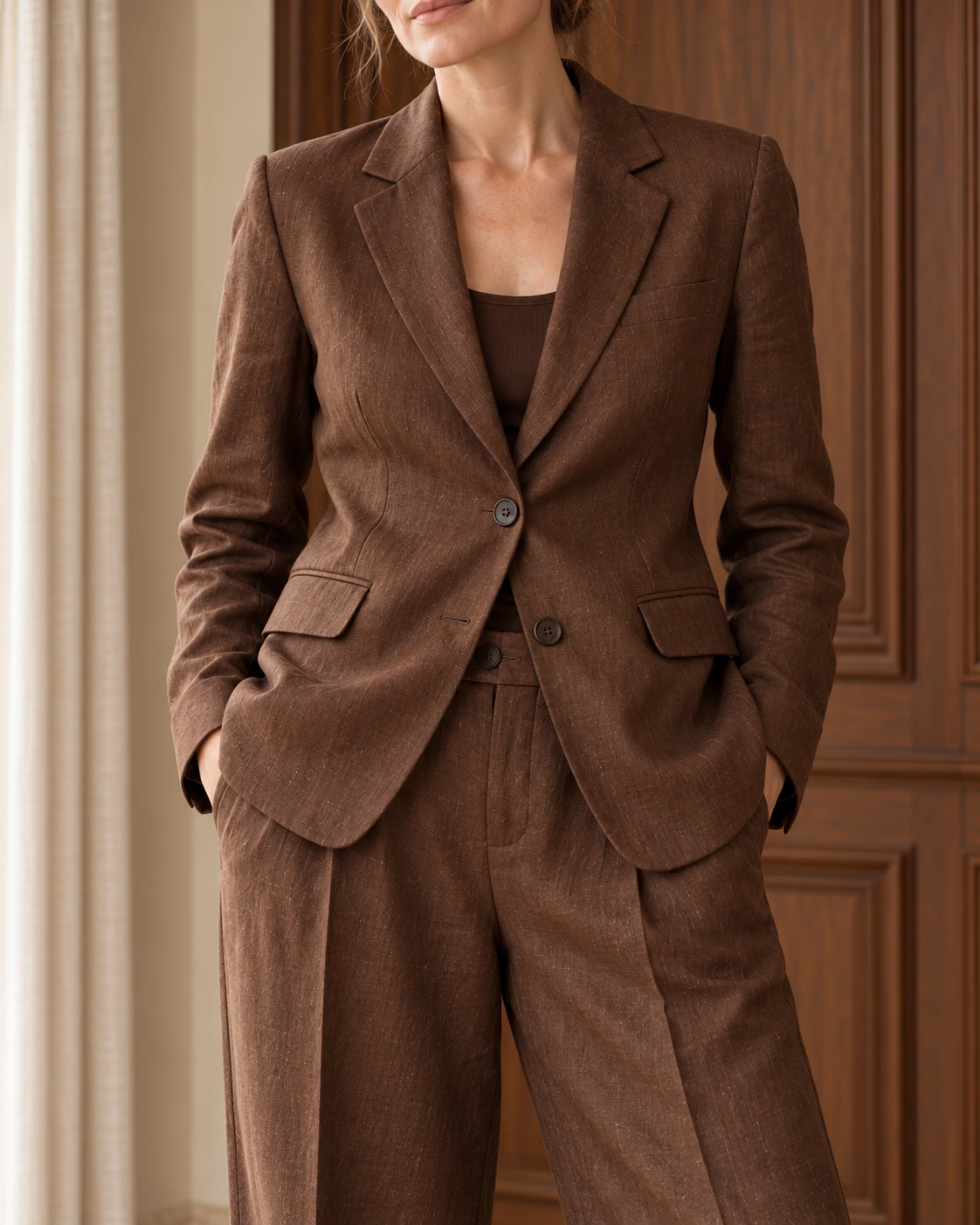
Match the outfit to the full schedule
Consider the ceremony, photographs, meal and evening separately. Will there be outdoor ground, stairs, transport or a change of venue? Will you be standing for a long period and then seated for dinner? These details influence footwear, hem clearance and the value of a layer more than a general wedding-style label.
Choose shoes early enough to inform the garment length. Flats can be a deliberate part of an occasion outfit. If you plan to change shoes later, test both with the hem before confirming a custom length. Avoid assuming a dress or trouser length shown on a model will sit the same way on you.
Compare a dress with a tailored-separate direction
A dress offers one main garment decision, while separates may give more flexibility in top and bottom proportions. A suit or coordinated set may feel natural if you prefer trousers. A wrap, shirt dress or straight dress can each offer another direction, but each has different fit and movement questions.
Consider what you want to notice in photographs and what you want to feel during dinner. Waist definition, sleeve shape and neckline are personal choices. If a design needs substantial alteration to meet your requirements, ask whether another listed pattern is a better starting point. A custom-fit option should not be treated as an automatic promise of complete redesign.
Make coverage and fabric questions specific
Tell the studio if you want an opening that remains secure when leaning forward, a sleeve ending at a particular point or a skirt that maintains your preferred coverage when seated. Those are clearer requests than “wedding appropriate” or “modest,” which can mean different things to different people.
If opacity under sunlight or flash matters, ask about the selected fabric and construction. Colour alone does not guarantee it, and a photograph cannot establish every lighting result. Use the linen library as a starting point, then confirm important fabric questions before making.
Test the layer as part of the outfit
A jacket, cardigan or other suitable layer may be useful through a long schedule. Try it with the intended sleeve and neckline, not just beside the garment on a hanger. Check whether it closes comfortably and whether removing it leaves an outfit you still enjoy wearing.
Weather protection needs a separate plan based on the venue and forecast. A decorative light layer may not be enough for a cold evening or rain. Ask the venue or couple about cover and access where necessary rather than expecting the clothing material to solve uncertainty about the setting.
Allow time for confirmation, delivery and assessment
For an important fixed date, the schedule should include time to choose, confirm details, make, ship and try the complete outfit. LINENELLAR’s published guidance separates making from shipping; neither should be collapsed into a guaranteed wedding-arrival date. Ask before ordering if time is limited.
LINENELLAR’s made-to-measure route adds 20% to the selected product price. You can use one optional note to begin the fit discussion, with details confirmed before making. Review the returns and alterations information before choosing a genuinely personalised order, and clarify essential changes in advance.
The product directions below are possible starting points for a conversation, not endorsements for every wedding dress code. A successful choice respects the couple’s plans, meets the practical demands of the day and lets you enjoy being present rather than continually adjusting what you are wearing.
Continue reading
Pieces to explore
Three designs to compare with the ideas in this article. Open each product for current pricing, available choices and construction details; confirm any requested fit or design change with our studio.
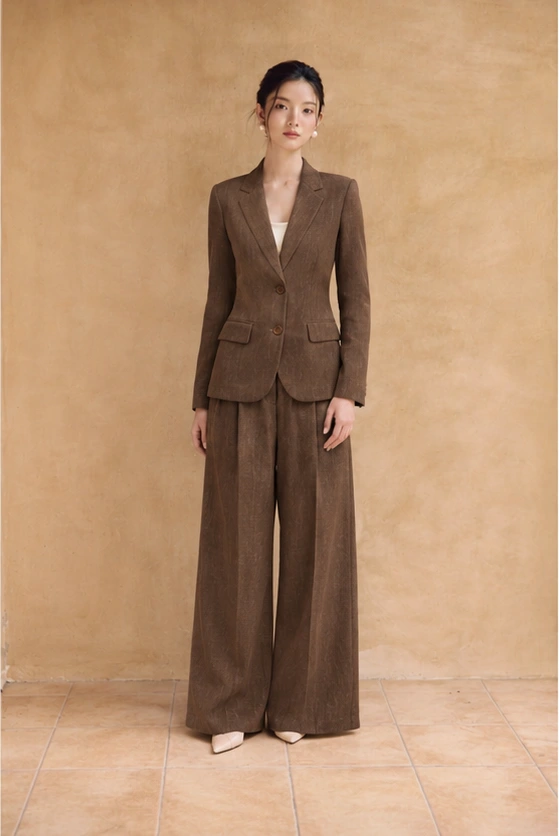

Linen Outfits for Men Over 60: From Everyday Wear to Dinner
Linen outfits for men over 60 do not need a separate set of style rules. A good starting point is the clothing you already enjoy: perhaps a shirt worn open at the neck, straight trousers, shorts or a familiar overshirt. The aim is to make those choices work for your present routine, from ordinary errands to dinner with friends.
Looking considered does not require a close fit everywhere. Equally, comfort does not require an oversized silhouette. Decide where you want room and where you prefer a cleaner line, then choose a design that supports that direction. A size label alone will not settle shoulder, torso and trouser proportions together.
Identify your preferred shirt direction
Compare a classic shirt, a camp-shirt direction and a band neckline. Think about how you actually wear the neck opening and whether you tuck the shirt. A style that looks appealing buttoned on a model may not be the one you enjoy wearing through a meal or while travelling.
Check shoulder and upper-back comfort with normal forward movement. If you often wear a shirt over another top, include that underlayer in the fit discussion. If you prefer it on its own, do not order extra volume solely for a layering possibility you rarely use. The intended job should guide the choice.
Build the everyday outfit from the trousers up
Choose a bottom that works with your usual shoes and the activities of the day. Full-length trousers, a cropped direction and shorts each create different practical requirements. Check waistband position, seated comfort and hem clearance rather than assuming a relaxed name guarantees all three.
Then add a shirt length that works in the way you wear it. An untucked shirt should be assessed with the trouser rise and your own torso proportions. A tucked shirt needs enough useful length without unnecessary fabric collecting at the waist. If you alternate between the two, tell the studio instead of assuming one photographed length is equally successful for both.
Move towards dinner with a few deliberate decisions
First check the venue’s expectations. Linen does not automatically establish a dress code, and a neat outfit may still be inappropriate for a particular restaurant or club. Once that is clear, a change of shoe, a different shirt or a suitable layer may be enough to alter the mood.
For example, trousers you wear during the day could work with a more considered shirt-and-shoe combination in the evening. Try the full outfit and decide whether the proportions still feel right. You do not need to add a jacket merely because of your age, nor remove one if it is part of the way you like to dress.
Keep seated comfort in the plan
Dinner is a useful reminder that clothing has to work sitting down. Check the waistband, rise and shirt front in a comparable outfit. Notice whether you keep loosening a belt, pulling the shirt down or adjusting the neck opening. Those habits identify specific questions for an online fit conversation.
A plain-language note can be precise: “I prefer a clean untucked shirt, with comfortable upper-back room when seated at a table.” For trousers: “I want this waistband position and enough room through the seat for a long meal.” Let the studio confirm the measurement method rather than adding guessed ease to your body figures.
Choose a palette that works with existing clothes
Take out the shoes and outer layer you use most. Compare the proposed linen shades with them before buying several coordinated pieces. A familiar neutral may offer repeated use; a stronger shade may bring new interest. Neither choice is dictated by being over 60.
Use the linen colour library to narrow your options. If matching a particular garment matters, ask what fabric confirmation is available. A colour name or a screen image is not an exact match guarantee. A deliberate contrast can be more satisfying than trying to reproduce a shade you cannot compare physically.
Order the fit route that solves a real need
Standard sizes can be the right choice when their proportions suit you. If your shoulder, torso length or top-and-bottom requirements differ, discuss made to measure. LINENELLAR adds 20% to the selected retail product price for this option. One note box is optional, and details are confirmed before making.
Check care guidance and the delivery plan as well as style. If dinner is part of a fixed celebration, leave time to try the complete outfit after arrival. A garment that fits your ordinary life well will often be more useful than one bought solely for a single photograph.
The shirts and trousers below offer several directions to compare. Choose the silhouette you enjoy and make its practical details clear. The best outcome is an outfit that feels recognisably yours during the day and appropriately considered when the plans become a little more special.
Continue reading
Pieces to explore
Three designs to compare with the ideas in this article. Open each product for current pricing, available choices and construction details; confirm any requested fit or design change with our studio.
Choosing Men’s Linen Shirts to Wear Untucked
An untucked linen shirt can look easy and intentional when its proportions work with the rest of the outfit. The important detail is not whether the hem follows one universal rule. It is where the shirt finishes on your body, how it relates to the trousers and what happens when you sit or reach forward.
For men who have bought tucked-in shirts for years, an untucked style can require a different comparison. A shirt that provides useful tuck length may feel too long when left out. A shorter style may look right standing but rise more than you want during movement. Assess the use you actually have in mind.
Start with the trousers and waistband position
Try a reference shirt with the trousers or shorts you will wear most. Note where you prefer the waistband to sit. A different rise can change how much of the shirt overlaps the bottom and how balanced the outfit feels, even when the shirt itself has not changed.
Look from the front and side, then sit. Does the hem collect heavily across the lap, catch around the seat or expose more than you prefer when reaching? These are practical observations to discuss. Do not shorten the shirt solely to satisfy a rule about the centre of a pocket or a fixed number of centimetres below the belt.
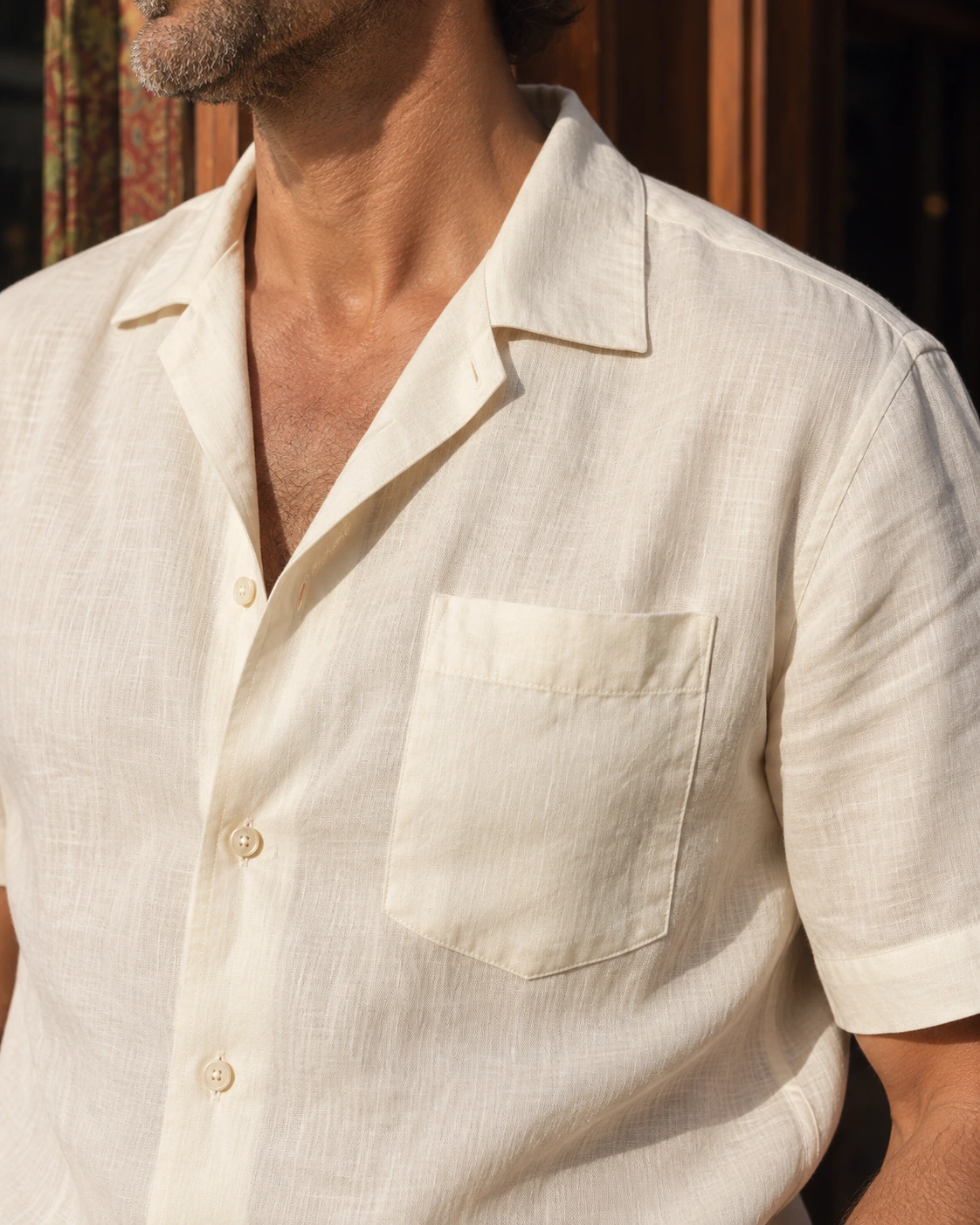
Consider the whole hem shape
A straight hem and a curved hem create different visual effects. A side opening or a longer back can also influence how the shirt sits. Check the actual product photographs and details rather than assuming all casual shirts are cut in the same way.
If you like a particular hem direction, choose a listed design close to it. Asking for a shorter length is not necessarily the same as asking for a different hem construction. The studio should confirm whether a proposed change preserves the design and what information is needed before making.
Separate body length from body width
When an untucked shirt feels overwhelming, length may be part of the issue, but width and shoulder position may contribute too. Buying a smaller size can shorten it while also reducing upper-back and chest room you need. Buying a larger size for comfort can make the hem feel even less suitable.
Compare a comfortable reference shirt and identify which dimensions you want to retain. For example, you may like its upper-body room but want a different finished length. Explain that distinction instead of requesting a general size change. Garment measurements should be labelled clearly and taken using an agreed method.
Check movement in ordinary situations
Reach towards a table, put a hand into a pocket and sit as you normally would. Notice whether the shirt rides up, pulls at the back or needs repeated smoothing. A few natural folds are not the same as restrictive tension or a hem that continually moves into a position you dislike.
If you intend to wear the shirt open over a top, test that arrangement too. The fronts may fall differently when unfastened, and the underlayer changes the available room. If both open and closed use are important, include both in the brief rather than fitting only the photographed version.
Relate sleeve and neckline to the intended mood
Short sleeves, long sleeves and a camp-style opening create different directions, but no one version is automatically right for older men. Choose the sleeve you enjoy and check upper-arm or cuff comfort as needed. A tidy untucked outfit can remain relaxed without requiring a narrow sleeve.
For dinner or another venue with expectations, check the dress guidance separately. Wearing a shirt untucked may or may not fit the setting. The fabric and fit cannot override a venue’s requirements, so clarify that before ordering a piece for a particular event.
Create a useful length reference
Try folding the hem of an existing shirt to compare positions while standing, then check the seated version. This helps identify your preference without claiming that a fold exactly reproduces a professionally made shorter shirt. Record the preferred result and ask the studio how to provide a finished-length reference.
An initial note could read: “I will wear this untucked with trousers at this waistband position. I like the room in my reference shirt but want a cleaner hem position. Please confirm how to measure it.” Avoid adding guessed allowances to body figures or copying a model’s length without context.
Confirm the order as a complete shirt
LINENELLAR’s made-to-measure option adds 20% to the selected product price, with optional notes and details confirmed before making. Standard sizing remains available. In either route, confirm the listed design, shade and any essential length request before production.
The shirt suggestions below offer different starting silhouettes. Choose the one closest to the untucked outline you want, then resolve length and movement together. A successful untucked shirt should look intentional and remain comfortable after you stop standing in front of the mirror.
Continue reading
Pieces to explore
Three designs to compare with the ideas in this article. Open each product for current pricing, available choices and construction details; confirm any requested fit or design change with our studio.

